Written by:
Jacksons Moving
Published:
November 2, 2026
Cardboard boxes or plastic bins for your move? Compare time, effort, risk and fit for each room so you know exactly what to grab before you start packing.
Moving boxes and plastic bins both get your belongings from one house to the next, but they are not interchangeable, and picking the wrong one for a given room costs you time, money on replacements, or a box of broken dishes. The short answer: cardboard boxes are the better choice for most of your move because they are easy to size to the load, recyclable, and simple to label and stack, while plastic bins earn their keep for a smaller set of items where moisture, pests, or long-term reuse matter more than convenience.
This comparison looks at moving boxes vs plastic bins across the things that actually affect your move: how long each takes to assemble and pack, how much physical effort they demand, what can go wrong, and which rooms or items each one is actually suited for.
Cardboard boxes win on flexibility and speed for a whole-house pack. Plastic bins win on durability and protection for a narrower list of items. Most moves end up using mostly boxes with a small number of bins mixed in, not one or the other exclusively.
Boxes come in sizes built for specific loads (small for books and dense items, medium for kitchen goods, large for linens and lampshades), so you are not stuck hauling an oversized bin that is only a quarter full. Bins come in a narrower range of sizes, which means you either overpack them past a safe carrying weight or waste space. That size flexibility is a big part of why boxes remain the default for a full home pack.
Boxes take a few extra minutes per unit to assemble and tape, but that time is offset by how fast you can grab the right size for whatever you are packing next. Bins are ready to use straight off the shelf, which saves assembly time but can slow you down when you are standing over an odd-shaped item trying to decide if it fits the one bin size you bought.
As a rough rule of thumb, plan on packing roughly a box a room per hour once you are in a rhythm, whether you are using cardboard or plastic. The material does not change that pace much; what changes it is how organized your packing supplies are before you start and whether you are sorting as you go instead of stopping to make decisions mid-task.
Bins are heavier on their own before you even add anything to them, and their rigid plastic shell does not flex the way cardboard does, so a full bin can be harder to get a grip on, especially going up or down stairs. Boxes are lighter empty and more forgiving to hold against your body, though they will eventually sag or tear if overloaded or if they get wet.
If your Phoenix-area home has stairs or a narrow hallway between rooms, lean toward boxes for anything you will be hand-carrying rather than rolling on a dolly. Save bins for items you can load low in a vehicle or stack where weight and grip matter less.
Plastic bins offer better protection against moisture and crushing for items that will sit in storage or travel exposed to the elements, which makes them a reasonable choice for documents, electronics, or anything you are worried about getting wet. Boxes depend entirely on how well you wrap and cushion the contents, since the cardboard itself provides no water resistance.
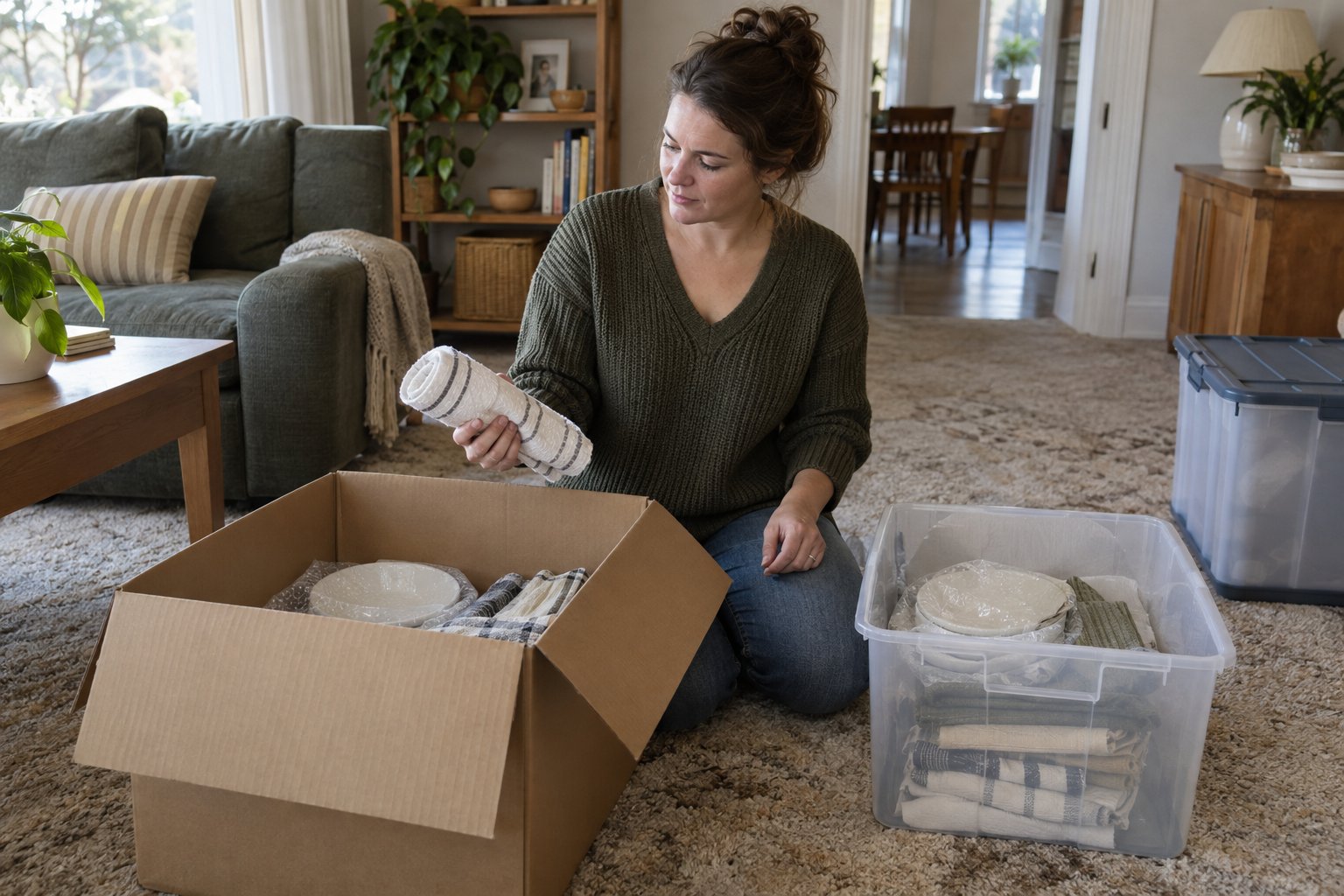
That said, a bin is not automatically safer for breakables. A rigid plastic shell can still let fragile items shift and collide inside if they are not individually wrapped and snugly packed, and a bin's tight-fitting lid can crack under weight if bins are stacked without checking the manufacturer's stacking limit. For genuinely fragile items like dishware or glassware, the wrapping and cushioning you use matters more than whether the outer container is cardboard or plastic.
Use boxes for the bulk of your move: kitchen items, books, clothing, linens, décor, and anything you are willing to recycle or break down after the move. Use bins for a short list of exceptions where their strengths actually matter.
If you are packing a kitchen or living room with a mix of both, it often works to wrap fragile items first using the same techniques either way, then decide box or bin based on where that item is going next, not just what is sitting on the shelf in front of you.
Choose boxes if you want the lowest-cost, most flexible option for a full household pack, you are recycling or breaking down the boxes afterward, and you do not have long-term storage plans for most of your items. This covers the majority of local and long-distance household moves.
Choose bins if you are moving items into storage for an extended period, you live somewhere with real moisture or pest exposure in a garage or shed, or you already own bins from past moves and want to get more use out of them before replacing them. Bins also make sense for a smaller, targeted pack, like an office move or a single room, where the reuse value outweighs the extra bulk and weight.
For most households, the practical answer is both: boxes for the bulk of the home, bins for the specific items where moisture protection or reuse actually pays off. If you are working with a professional packing service, ask what materials they bring and whether fragile items get extra wrapping regardless of which container they end up in.
Walk through your home one room at a time and ask two questions: will this item sit in storage or get exposed to weather, and do I want to keep the container afterward? A yes to either points toward a bin. Everything else can go in a box.
This room-by-room approach also makes it easier to estimate how many of each you will need before moving day, rather than guessing and making a last-minute supply run. The moving insurance options available for your move can also be worth reviewing before packing day, particularly if you are packing higher-value items yourself rather than having a crew handle it.
For general packing guidance that applies to both boxes and bins, the EPA's guidance on reducing, reusing and recycling household items is a useful reference when you are deciding what to keep, donate, or pack at all before the move.
Whether you land on boxes, bins, or a mix of both, the bigger time and effort savings usually come from how the move itself is handled, not the container type. A crew that knows how to load, carry, and protect furniture through tight doorways or stairs cuts far more time off moving day than switching packing materials. If you are moving in or around Mesa, AZ, local Mesa moving company support can handle the loading and carrying while you focus on what goes in each box or bin.
For a home with a lot of packing to get through, pairing your own box-and-bin sorting with local moving services for the heavy lifting is often the most efficient split of labor on a tight timeline.
Planning your move? Request a quote from Jackson's Moving.
Yes, that is one of the main reasons people choose bins for certain items. A durable bin with a secure lid can go straight from the moving truck into a closet, garage, or shed without needing to be repacked into a different storage container.
Used boxes work fine as long as they are not torn, crushed, or damaged by previous moisture exposure. Check the bottom seams and corners before packing anything heavy into a used box, since that is where wear shows up first.
Put heavier boxes and bins on the bottom and lighter ones on top, and avoid stacking bins higher than their lid rating allows, since most plastic lids are not designed to support unlimited weight above them. Boxes should be stacked by size, largest on the bottom, to keep the stack stable.
Let the crew know which bins contain fragile or valuable items and which boxes are packed heavier than they look, since weight is not always obvious from the outside of a sealed container. Pointing out anything unusually heavy or delicate before loading helps the crew handle it appropriately.
If you do not have a clear reuse plan afterward, boxes are generally the simpler choice since they can be recycled or broken down flat once you are unpacked, while empty bins take up storage space of their own if you have no use for them.
Read genuine feedback from our satisfied customers to understand why we are the trusted choice for moving services.
From Phoenix to communities across the Valley, Jackson's Moving is here when you need residential, commercial, or long-distance moving services. Request your free quote today.