

Written by:
Jacksons Moving
Published:
November 9, 2026
Comparing modular, track-arm, and one-piece sectionals for ease of disassembly and reassembly before your move, with a rule of thumb for timing.
Modular sectionals built from separate connected pieces are the easiest to disassemble and reassemble when moving, because each section is already designed to detach and reattach on its own. One-piece or permanently joined sectionals are the hardest, since they were never meant to come apart and usually have to move as a single oversized unit. Track-arm and clip-connected sectionals fall in between, depending on how their pieces attach to each other.
If you are staring down a move and wondering whether your sectional is going to be a quick job or an afternoon project, the type of connector holding it together matters more than the size, the brand, or even the number of cushions. Here is how the main styles compare on time, effort, risk, and who each one actually suits.
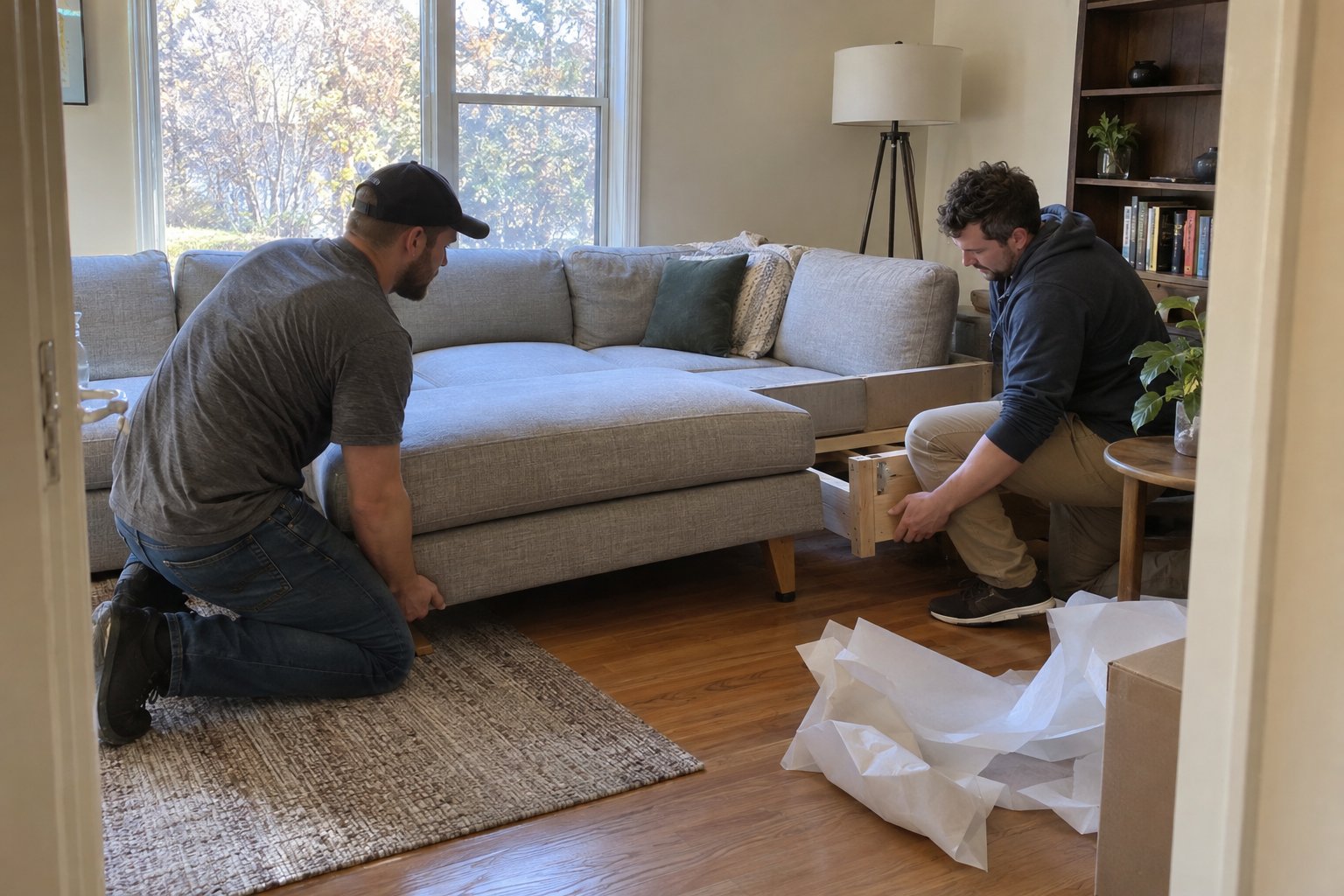
Modular sectionals are built from individual chairs, corner pieces, and armless sections that bolt, clip, or hook together, which means they were designed to separate. This is the style that comes apart with the least trial and error, because each section can be carried through a doorway on its own instead of wrestled as one giant shape.
On time: a modular sectional with four or five pieces typically takes less time to break down than a comparable one-piece sofa, since you are removing connector bolts or clips rather than fighting with upholstery or frame joints. On effort: each section is lighter and more manageable for two people, reducing the risk of a dropped corner or a scraped doorframe. On risk: the main thing to watch is keeping track of small hardware, since lost bolts or brackets can turn an easy reassembly into a frustrating one. Modular sectionals suit anyone who already knows (or can quickly find) how their pieces connect, and anyone whose new home has narrow hallways or doorways that would never fit a full sectional in one piece.
Look underneath or behind the cushions for the connector type. Most modular sectionals use one of a few systems: cam locks, bolted brackets, or simple interlocking clips. Photograph each connection point before you disconnect it so reassembly is a matter of matching the photo rather than guessing.
Track-arm sectionals, where one section slides into a track along the neighboring piece, come apart reasonably easily once you find the release mechanism, but they are less intuitive than a bolted modular design. These are common in mid-range furniture lines and usually separate by lifting, sliding, or pressing a hidden latch rather than removing visible hardware.
The tradeoff here is mostly about effort versus guesswork. Disassembly itself does not take much physical strength, but finding the release point can take longer if you do not have the original assembly instructions. Reassembly is usually just the reverse motion, sliding the track back into place, which makes this style forgiving for a first-timer as long as you remember which piece went where. This option suits households who kept their furniture's original paperwork or can look up the model online, and who are not in a rush on moving morning.
A one-piece sectional, where the frame is built as a single continuous unit rather than separate connected sections, cannot be taken apart at all in most cases. The only way to make it smaller is to remove the legs and tip it on its side, which helps with doorways but does not reduce its overall bulk or weight.
On time: there is no disassembly step, so this is actually the fastest sectional to prepare, since there is nothing to take apart. On effort and risk: this is where it gets harder, because the whole piece has to be carried, tilted, and maneuvered as one awkward shape, often through tight turns. This is the style most likely to need a few extra hands or furniture sliders to move safely without damaging floors, walls, or doorframes. One-piece sectionals suit homes with wide, open floor plans and doorways, and movers who have the help on hand to carry a large piece as a single unit.
Check the undersides of the cushions and the back of the sectional along each seam. If you can see a visible seam where two pieces meet, with bolts, brackets, or a track running along it, you have a modular or track-arm design that will separate. If the frame and upholstery run continuously across what looks like a seam, with no visible hardware or gap, you most likely have a one-piece or permanently joined piece.
As a rule of thumb, allow about half a day to disassemble, move, and reassemble a modular sectional of four to six pieces, including wrapping and labeling hardware, while a one-piece sectional of similar size needs most of that same time just for careful carrying and maneuvering since there is no breakdown step to speed things along.
Whatever type you have, the same groundwork makes the move smoother. Remove all cushions and pillows first so you can see the frame and connectors clearly. Bag and label any bolts, cam locks, or brackets by section, since matching sets look identical once mixed together. Wrap exposed metal connectors or feet so they do not scratch the frame of another piece during transport, and measure your new doorways and hallways ahead of time so you know whether a one-piece sectional will fit or needs to go in on its side.
Standard furniture like beds and tables can be taken apart and put back together as part of a move, and our furniture moving service covers that kind of disassembly and reassembly along with careful carrying and padding for every piece, sectionals included, through the home and onto the truck. For moves that involve a full household rather than a single piece, our residential moving services cover the loading end to end.
A sectional that survives a local move intact does not always hold up the same way over a long haul, where it sits loaded for longer and shifts more during transport. For moves outside the Phoenix area, our long-distance moving team can talk through whether a borderline piece is better off disassembled before loading rather than risking it shifting en route. If you are relocating from Chandler, AZ or Gilbert and want someone to take a look at a specific sectional in your home ahead of moving day, our Chandler moving company and Gilbert moving company teams serve those areas.
For documenting the hardware and condition of a sectional before a move, the guide to packing fragile items safely covers labeling and padding techniques that apply just as well to furniture hardware bags as to breakables.
A large sectional represents enough replacement value that it is worth understanding your coverage options before moving day, especially for a one-piece design that has to be carried as a single unit. Reviewing moving insurance options ahead of time means you are not deciding on coverage while the piece is already halfway out the door.
Planning your move? Request a quote from Jackson's Moving.
Yes, if it fits through your doorways and hallways as a single piece. Measure the tightest turns in both the old and new home before deciding, since a sectional that clears one doorway can still get stuck on a stairwell landing.
Most modular sectionals only need a basic set: a Phillips or flathead screwdriver, an Allen wrench if the connectors use hex bolts, and small bags or containers to keep hardware sorted by section.
Photograph each connection point before removing it, then bag the bolts or brackets from that spot and label the bag with the section name. Tape the bag to the underside of the matching piece so it travels with it.
No. Connector types vary by manufacturer and even by product line, which is why it helps to check the underside of the cushions and the back seams before assuming your sectional works like one you have seen before.
Tilting a one-piece sectional onto its side can help it clear a doorway, but check for exposed legs, fabric stretching, or frame stress points first, and have a second person support the opposite end so it does not tip further than intended.
Read genuine feedback from our satisfied customers to understand why we are the trusted choice for moving services.
From Phoenix to communities across the Valley, Jackson's Moving is here when you need residential, commercial, or long-distance moving services. Request your free quote today.