Written by:
Jacksons Moving
Published:
October 22, 2026
Learn how to move heavy furniture up or down stairs without injury or damage, including the right grips, equipment, and when to call in professional movers.
Stairs turn an ordinary furniture move into the single most injury-prone part of moving day. Learning how to move heavy furniture on stairs comes down to three things: the right grip on the piece, the right equipment underneath it, and a plan for the turns and landings before anyone lifts a finger. Skip any of those and you risk a thrown-out back, a gouged stairwell wall, or a sofa wedged sideways on a landing with nowhere to go.
This guide breaks down the techniques that actually work on staircases, the equipment worth buying or renting, and how to tell when a piece is too much for two people even with good form.
Stairs are dangerous because they remove your ability to walk a heavy object in a straight line. Every stair forces a small lift, a shift in your center of balance, and often a turn at a landing, all while you are carrying weight you cannot easily set down mid-step.
On flat ground, two people carrying a dresser can stop, adjust their grip, or set it down if something feels wrong. On a staircase, stopping mid-flight usually means holding the full weight in place while someone else repositions, which is exactly how backs get strained and knees give out. Narrow stairwells, 90-degree turns, and low ceilings at the landing compound the problem, especially in older homes or multi-story townhouses common in the Phoenix area.
The right equipment shifts weight off your back and onto your legs, straps, or wheels, which is where it belongs. A stair-rated furniture dolly, forearm-style lifting straps, and corner guards are the three tools that make the biggest difference for most households.
Straps and dollies rated for stair use are worth the rental cost on almost any move involving a flight of stairs; a dropped or dragged piece of furniture usually costs more to repair or replace than the equipment would have.
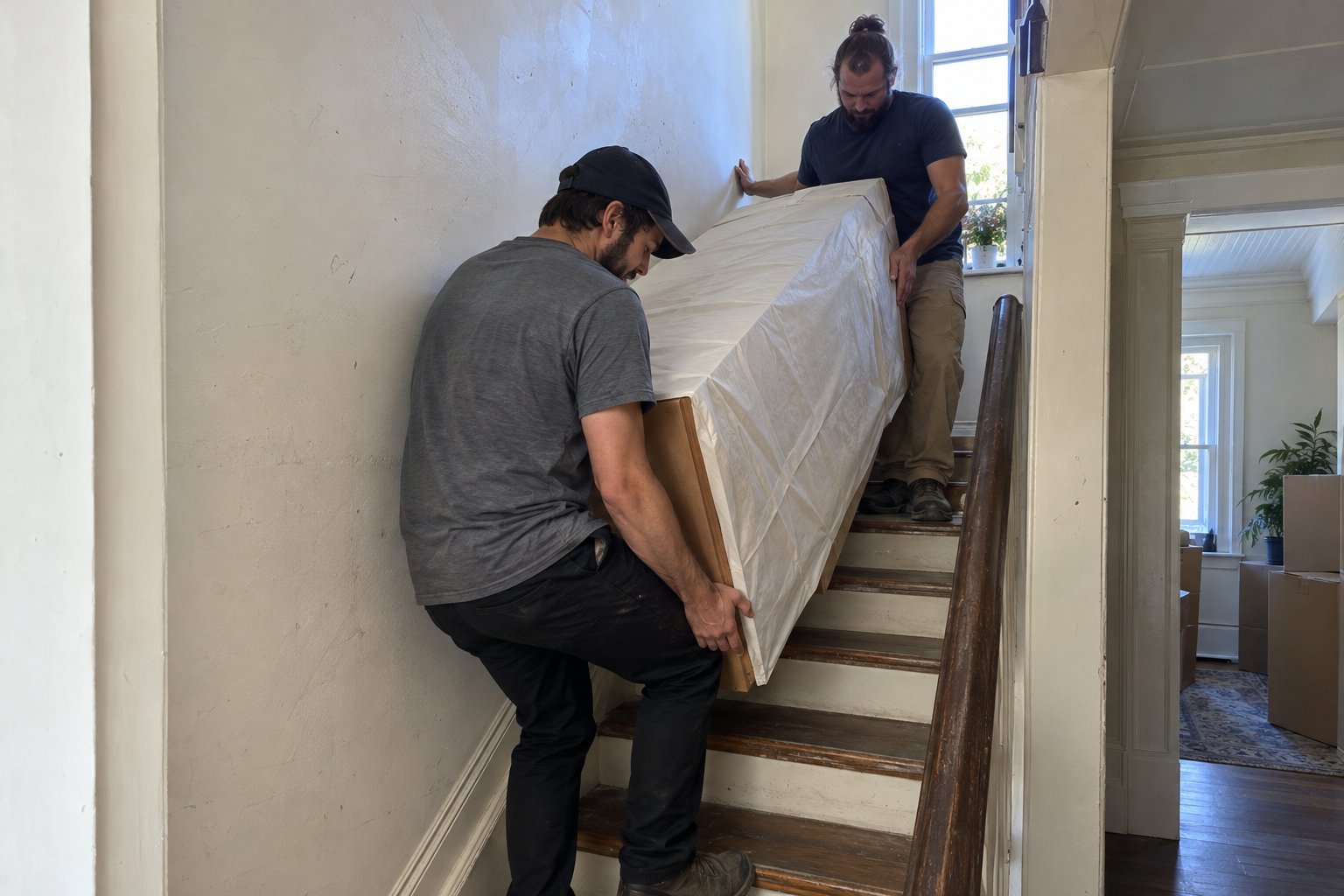
The safest method is to keep the heaviest end on the downhill side, let the person below take most of the weight on their legs, and move one stair at a time with constant verbal communication. Rushing a staircase carry is the single most common cause of dropped furniture.
Tip the item onto its side or end if the shape allows, since a narrower profile clears turns and doorways more easily than carrying it flat. Sofas usually travel better on their end; dressers and bookcases often do best tipped onto their back with drawers or shelves removed and taped shut.
The stronger carrier should be below the item on an upward climb and below it again on a downward one, since the lower position bears more of the weight on a staircase. Whoever is above should focus on guiding angle and watching for the top of the frame clearing the ceiling or light fixtures at the landing.
Agree on simple commands before you start lifting, such as "step" for each stair and "hold" for a pause. Silent carries are where most accidents happen, because one person adjusts their grip without warning and the other is caught off guard.
Moving anything heavier than a small chair or end table up or down a staircase alone is not recommended, even with a dolly. A single person has no way to correct a shift in balance mid-stair, and a fall while carrying a heavy object on stairs is one of the more common sources of serious moving injuries.
A few signs it is time to stop and get a second set of hands, or call in professional movers:
Stairwells take more wall damage during a move than almost any other part of the house, simply because the carrying space is so tight. A few minutes of prep before the carry begins saves a much longer repair job afterward.
Lay down a runner or moving blankets on the stairs themselves if the flooring is hardwood or tile, since a dropped corner can chip or scratch finished wood in a single hit. Tape corner guards to any wall edges at landings and turns, and remove light fixtures, sconces, or anything else protruding into the carry path before you start rather than working around it mid-lift. For a deeper look at protecting the rest of the home during a move, see our guide on how to move furniture without damaging floors and walls.
If your move involves multiple heavy pieces and more than one flight of stairs, hiring professional movers is usually the safer and faster choice. A trained crew carries furniture on stairs daily, uses commercial-grade straps and dollies, and knows how to read a staircase before committing to a lift.
Jackson's Moving crews handle the carrying and heavy lifting within the home as part of standard furniture moving service, including navigating stairwells, tight turns, and landings safely. If you are packing the rest of the home yourself and just need help with the heavy pieces, that is a common and reasonable way to split the work.
If you are in a multi-story home or townhouse anywhere in the Mesa area, our local crews are familiar with the stair layouts common to the neighborhood and can plan the carry before moving day arrives.
Walk the staircase before moving day and note anything that will affect the carry: the width of the narrowest point, the angle of any turn, the height of the ceiling at each landing, and whether the flooring needs protection. Measure your largest pieces against that narrowest point ahead of time rather than discovering a mismatch mid-move.
Clear the stairwell completely of rugs, decor, and anything hanging on the walls before the carry starts, and confirm you have the right equipment, extra hands, and a plan for which piece goes down or up first. Heavier, less flexible items like a dresser or china cabinet should usually go before lighter, more maneuverable pieces so the stairwell stays clear for the awkward carries.
Most standard sofas need at least two people on stairs, and a large sectional piece or a staircase with a tight turn often calls for three. The person below should take the heavier end of the load.
Remove the drawers first to cut the weight, tip the dresser onto its back if it fits the stairwell better that way, and use lifting straps so both carriers keep a hand free for balance at turns and landings.
A stair-rated dolly can help with a recliner, but a sleeper sofa's uneven weight distribution and metal frame often make a dolly unreliable on stairs. These pieces are usually safer carried with straps and an extra person.
Policies vary by company and by how many flights are involved, so it is worth asking for a written estimate that accounts for your specific staircase before booking.
Lower back strain is the most common injury, usually from twisting mid-carry or taking on too much weight without a strap or dolly. Pinched fingers and ankle injuries from missteps are also common on tight staircases.
Read genuine feedback from our satisfied customers to understand why we are the trusted choice for moving services.
From Phoenix to communities across the Valley, Jackson's Moving is here when you need residential, commercial, or long-distance moving services. Request your free quote today.